
We design intelligent chips in intelligent ways.
AI-Powered Chip Design
We develop methods and tools that shorten the chip design cycle, from early design space exploration and logic synthesis to physical implementation and timing closure. Our research brings physical, timing, and thermal awareness into earlier design decisions, combining AI/ML, large language models, and reusable design infrastructure.
Early Exploration for 3D & Chiplet Systems
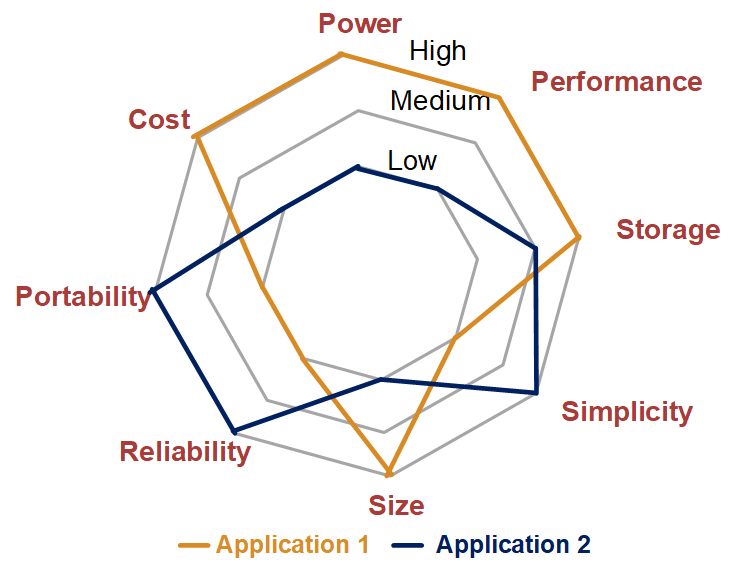
Good design decisions require fast feedback before expensive implementation. We explore architecture, partitioning, and packaging choices with models that expose their physical and system-level consequences early. Recent work includes Cool-3D for thermal-aware exploration of microfluidic-cooled 3DICs and ChiPlanner for physically aware, timing-driven planning of 2.5D multi-chiplet systems. Our exploration also examines CPU–FPGA partitioning costs for transformer workloads. Current topics include:
- Early thermal and physical modeling for 3DICs and multi-chiplet systems
- Hardware partitioning and architecture exploration for AI workloads
- Fast timing prediction and cross-corner design feedback
Learning-Driven EDA: From Synthesis to Signoff
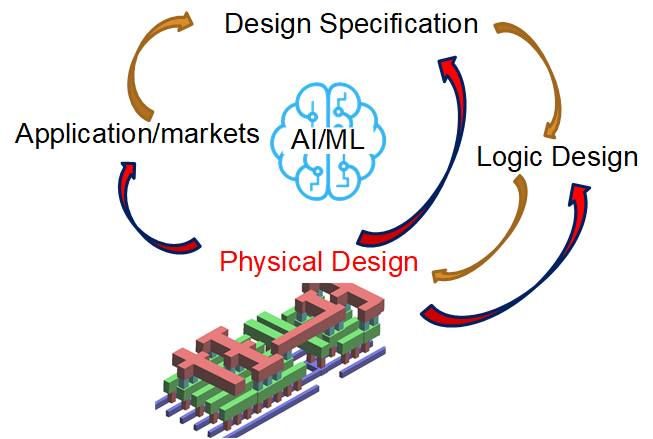
We combine learning-based methods with circuit structure and physical design knowledge to improve synthesis, placement, and timing closure. Recent work spans dataflow-aware macro placement with DARE and IncreDFlip, physically informed technology mapping with PRISM, early multi-bit flip-flop clustering, and cross-corner timing prediction. We also investigate generative graph models for analog sizing and LLM-assisted timing report analysis through AutoTimer. Our goal is to make design feedback available earlier and help designers navigate implementation tradeoffs with less manual iteration.
Agile Design Ecosystems: Data, Tools & Flows
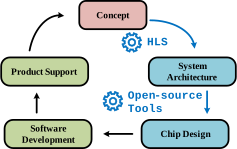
Agile hardware development depends on reusable tools, representative data, and efficient experimentation. Building on our work in configurable hardware and high-level design, we develop infrastructure that supports repeatable evaluation and faster iteration. Recent contributions include the R-Zoo rectilinear floorplan benchmark, the collaborative CORE synthesizable RTL dataset, and circuit data augmentation through CircuitS2L and Sketch-to-Style. Elastic EDA explores learning-based cloud resource allocation for EDA workloads. Together, these efforts support the shift-left design approach examined in our recent survey, connecting early feedback with practical implementation flows.
Energy-Efficient & Resilient Computing
We investigate how circuits, architectures, and software can work together to improve energy efficiency and reliability. Our research connects device aging and process variability with workload behavior, numerical precision, memory organization, and thermal design. We seek design choices that balance performance, energy, accuracy, and resilience across the system stack.
Lifetime-Aware Circuits & Self-Healing Systems
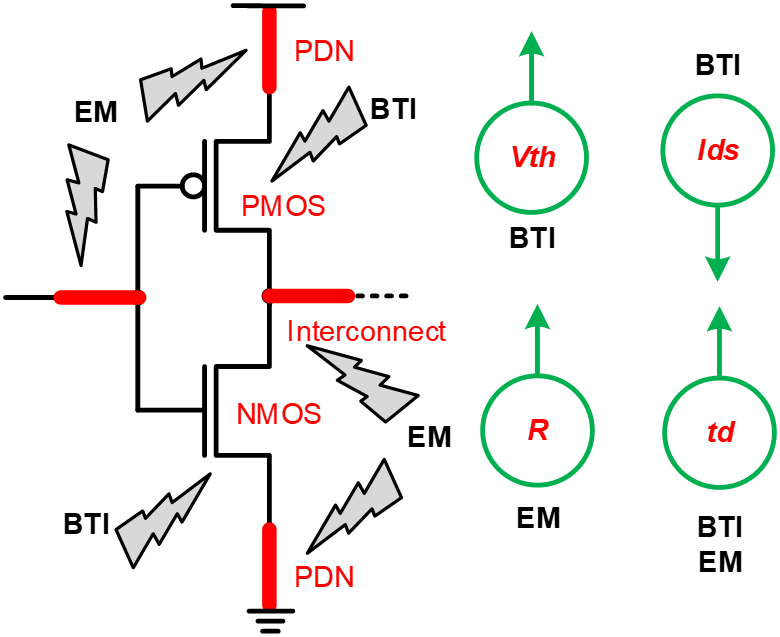
Device aging and process variability can change circuit behavior throughout a chip’s operating life. We study how to model these effects and incorporate lifetime considerations into design and optimization. Recent work includes RESIST, which applies residual reinforcement learning to lifespan clock-tree reliability optimization, aging and variability analysis of SRAM-based in-memory computing, and aging analysis of CMOS synaptic circuits. Our review of reliable integrated-circuit design brings together techniques for extending silicon lifetime. This direction builds on our work in active recovery and self-healing, with the aim of managing reliability alongside performance and power.
Algorithm–Hardware Co-Design for Efficient AI
We co-design algorithms and hardware for efficient AI inference, with particular attention to edge platforms and memory-intensive workloads. Recent work includes Edge-MPQ and mixed-precision FPGA inference, DDPA activation-function acceleration, and PIMScope modeling of LPDDR processing-in-memory for transformer inference. We also explore accuracy–energy–resilience tradeoffs through noise-guided mixed-precision search. Collaborative work extends this direction to tunable numerical precision with FlexPosit and efficient LLM execution. Across these projects, we examine how precision, data movement, computation, and hardware partitioning shape system efficiency.
View our publications →